
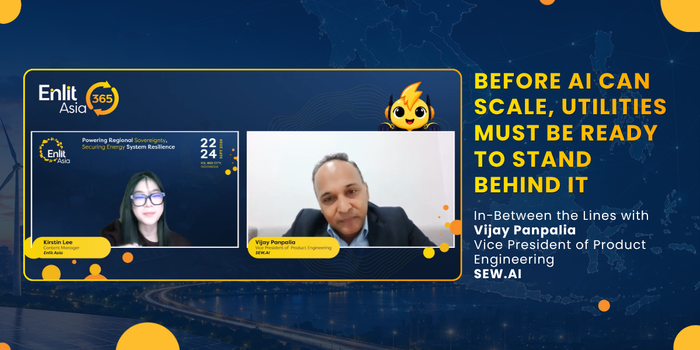
Before AI Can Scale, Utilities Must Be Ready to Stand Behind It
When a customer photographs an electricity meter and submits the reading through a digital platform, the apparent simplicity of that interaction conceals a series of decisions. The system must establish whether the image is genuine, interpret the reading accurately, compare it with historical consumption and determine whether the information can be accepted for billing. If something appears unusual, there must also be a process for examining the exception and deciding what happens next.
For Vijay Panpalia, Vice President of Product Engineering at SEW.AI, this illustrates both the opportunity and the responsibility that comes with introducing artificial intelligence into utility operations. Drawing on more than two decades of experience in the utility industry, including years spent working within electricity utilities before moving into technology development, he sees organisational readiness as central to whether AI can become a dependable part of everyday operations. As utilities invest in more intelligent systems for customers, workforces and electricity networks, the question extends beyond what the technology can perform to whether the organisation can sustain its performance and remain accountable for the decisions it supports.
When a Successful Pilot Meets Everyday Operations
The distinction between demonstrating a technology and making it part of everyday utility operations is familiar to Panpalia, who has observed a change in how utilities are thinking about implementation. In his experience, organisations are increasingly moving away from isolated proof of concept projects towards phased implementation, where the intention is to establish an operational foundation and expand the use of technology as the organisation becomes ready to support it.
This reflects a recognition that the technical performance of an application, however promising, does not necessarily establish whether it can be sustained within an operating utility. Its deployment may depend on established business processes, several existing information systems and employees whose responsibilities were defined long before the technology was introduced. Panpalia believes that the more persistent difficulties often lie in the readiness of people, processes and data, rather than in the technical capabilities of AI itself.
The automated meter reading example illustrates these dependencies. Panpalia described how SEW.AI's application enables customers without advanced metering infrastructure to submit photographs of their meters, which are then processed through image validation, optical character recognition and checks against historical consumption patterns before billing information is generated. For the customer, this can reduce the effort involved in obtaining a bill, while the utility can automate activities that would otherwise require manual intervention. Behind that interaction, however, the organisation must maintain accurate information, establish acceptable parameters for readings and ensure that the billing system can process the resulting data.
Panpalia emphasises that human accountability remains part of this process. Where the system identifies an anomaly or rejects a reading, people must still intervene to determine how the exception should be handled. His guiding principle is "never automation without accountability", a distinction that places responsibility for the outcome firmly with the utility, regardless of how much of the process has been automated. Technical accuracy and processing efficiency remain important measures, but they need to be considered alongside the organisation's ability to validate results, resolve exceptions and explain decisions when they are challenged.
Understanding the Organisation's Actual Starting Point
Panpalia's experience working inside utilities has reinforced the importance of understanding existing operational capabilities before determining which technologies should be introduced. During his Enlit Asia 365 interview, he offered a principle that captures much of his thinking: "AI maturity cannot be higher than the organization's digital maturity."
For Panpalia, this means examining whether employees are prepared to work with intelligent systems, whether existing processes can capture the information required and whether the network and supporting infrastructure are capable of providing reliable data. These conditions are closely connected, and improvements in one area may be of limited value if the others remain insufficiently developed. A utility may be able to acquire an advanced AI application, for example, while still lacking the operational information or established responsibilities needed to use its outputs consistently.
He recalled working with a utility in Mumbai to develop a maturity model that could identify gaps in the organisation's existing capabilities. The exercise provided a basis for understanding what needed attention and establishing a plan for addressing those requirements. It also reflects a broader lesson from his career: the importance of examining the conditions under which a technology will operate, rather than assuming that its introduction will resolve difficulties already present within the organisation.
These considerations become more significant as electricity networks accommodate changing patterns of consumption and increasingly diverse sources of information. Panpalia points to the growth of advanced metering infrastructure, rooftop solar, electric vehicles and battery storage as developments that are making utility operations more complex. Greater access to information creates opportunities for better forecasting, customer engagement and operational decisions, but the value of that information still depends on whether it can be captured, maintained and interpreted within the appropriate business processes.
Existing digital systems can also complicate this task. Panpalia describes utilities maintaining separate customer platforms for prepaid and postpaid accounts, conventional and advanced meters, or residential and enterprise consumers. Such arrangements may have developed to meet legitimate service requirements, but they can make it more difficult to connect information and establish a consistent understanding of customer interactions. His emphasis on a common digital foundation is therefore closely linked to the need for customer, workforce and grid functions to exchange information reliably, while continuing to support the different requirements of the people and operations they serve.
For utilities in ASEAN, where organisations operate with different levels of automation, existing infrastructure and institutional capabilities, the implication is that AI investment cannot be considered independently of digital maturity. An application that can be supported within one organisation may require substantial preparatory work within another. Understanding these differences gives utility leaders a stronger basis for determining which capabilities are ready for deployment and which depend on improvements to existing systems, processes or workforce expertise.
Building Capability Alongside Implementation
Panpalia recommends developing digital maturity plans and AI investment priorities together, allowing each to inform the other as implementation progresses. One part of this work involves assessing existing capabilities, identifying gaps and establishing a roadmap for improvements to people, processes, data and infrastructure. In parallel, utilities should examine the AI applications relevant to different business functions, determine what each is intended to improve and establish the information and integration requirements needed for deployment.
The relationship between these activities is important because individual AI applications can help reveal the limitations of the systems on which they depend. A utility seeking to improve customer billing, for example, may discover that the more demanding work involves connecting metering information with customer records, billing rules and the processes used to investigate unusual consumption. Understanding these dependencies early allows improvements to digital infrastructure and business processes to be planned alongside the application itself, rather than addressed only after implementation difficulties emerge.
Panpalia's reflections on his own career offer another lesson about preparing an organisation for implementation. During the interview, he recalled hearing a utility leader challenge the familiar practice of documenting lessons learnt at the end of a project, when organisations could instead begin new initiatives with "lessons to be implemented at the start of the project". The observation stayed with him, and he described how he now incorporates previous experience into the planning of new technology projects, using checklists to identify and address difficulties that teams have encountered before.
This discipline becomes more consequential as AI moves into activities on which utilities and their customers increasingly depend. The responsibilities associated with data quality, system integration, governance and workforce readiness do not end when an application enters service. They must continue to be maintained as the technology develops, operating conditions change and intelligent systems become more closely connected with established utility functions.
Panpalia's experience suggests that organisations will be better placed to sustain AI when they regard implementation as a continuing responsibility, supported by people who understand both the technology and the operational environment in which it is being used. This requires leadership to consider not only the capabilities an investment is expected to deliver, but also how those capabilities will be governed, maintained and incorporated into the work of the organisation over time.
For utility leaders, the decisions made before deployment may ultimately determine how much value can be realised afterwards. As AI applications become more capable and increasingly connected with customer services, workforce activities and network operations, there will be greater expectations for utilities to demonstrate that the information behind those systems is dependable and that responsibility for their decisions remains clear.
The next stage of AI adoption will therefore place considerable weight on the less visible work of strengthening operational capabilities and preparing organisations to use intelligence responsibly. Panpalia's view is that the utilities most likely to succeed will be those that treat AI "not as an IT project, but as a long-term organization capability".